


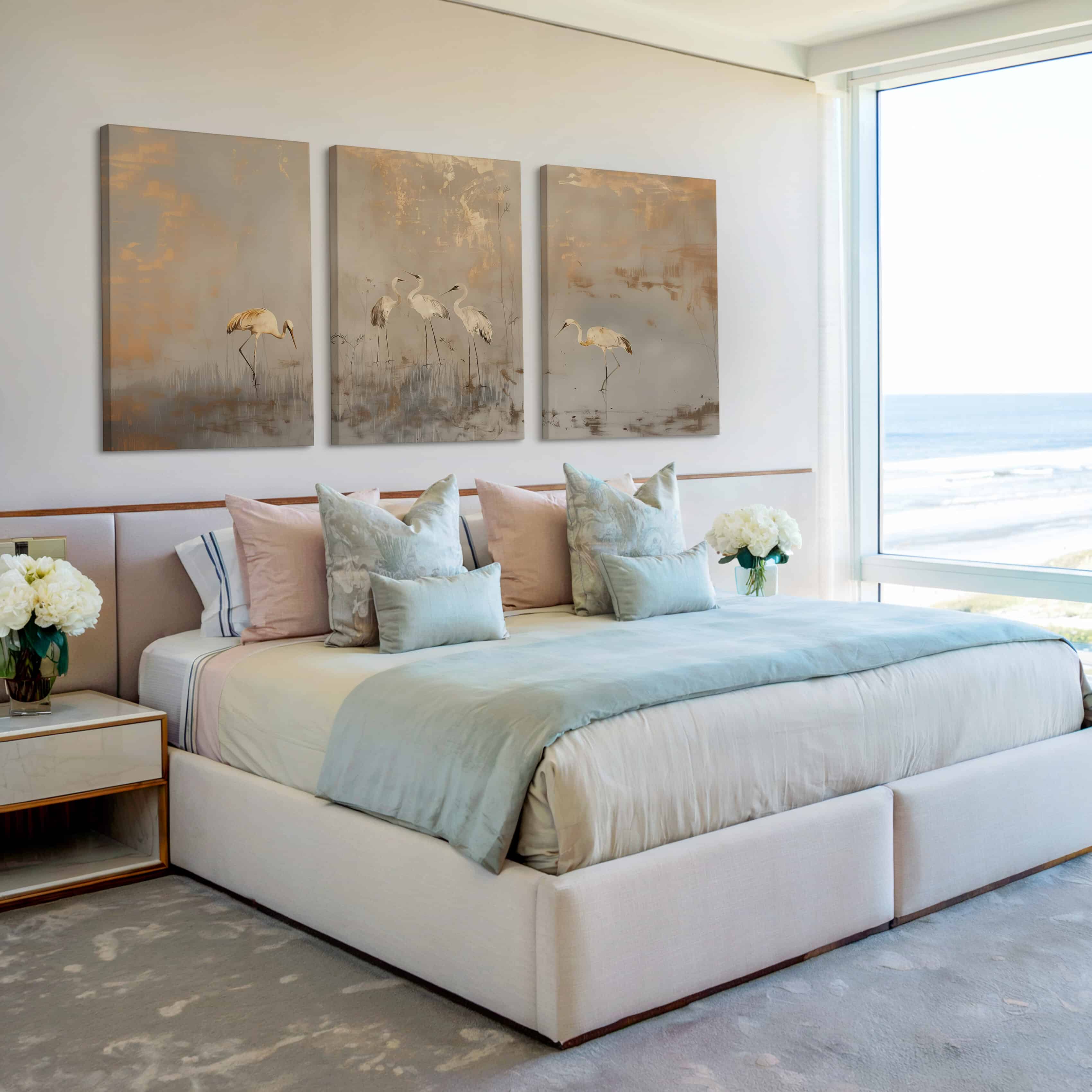
As minimalism evolves in 2026, two aesthetic philosophies are leading the way: Japandi and Wabi Sabi. Both rooted in Japanese design traditions, they offer calm, intentional interiors – yet each brings its own personality. Whether you’re drawn to clean Scandinavian-Japanese fusion or quiet imperfection and organic texture, there’s a minimalist style to suit your vision.
At iuliia.store, we translate these principles into wall decor – with triptych cloud prints, Japanese crane posters, and minimalist artworks that reflect harmony, stillness, and natural beauty.
What Is Japandi?
Japandi combines Scandinavian function and light with Japanese aesthetics and simplicity. The result is a clean, airy space grounded by natural materials and muted tones – think soft wood, linen, handmade ceramics, and quiet visual rhythm. In wall art, Japandi often leans toward soft neutral palettes, abstract forms, and open space.
Our 3-piece cloud triptychs – featuring warm beige skies and abstract misty forms – fit perfectly within Japandi interiors. Their horizontal balance and subtle gradients evoke calm and intentionality without overwhelming the space.
What Is Wabi Sabi?
Wabi Sabi celebrates imperfection, aging, and the passage of time. It values simplicity, but not symmetry – favoring cracks, texture, irregular forms, and earthy beauty. Unlike Japandi’s clean lines, Wabi Sabi embraces nature’s quiet unpredictability.
This philosophy pairs beautifully with art that features weathered landscapes, soft grainy textures, and traditional motifs. Our crane wall art – often set in misty mountains, seasonal blossoms, or faded skies – reflects the spirit of Wabi Sabi through timeless subjects and subtle brush-inspired compositions.
Key Differences at a Glance
| Japandi | Wabi Sabi |
|---|---|
| Clean lines, minimal structure | Organic shapes, irregular forms |
| Neutral tones with contrast | Earthy, muted, aged tones |
| Modern calm, functional minimalism | Poetic imperfection, rustic serenity |
| Scandi influence + Japanese design | Purely rooted in Japanese tradition |
| Ideal for abstract triptychs and clean prints | Ideal for aged textures, nature, and symbolism |
How to Decorate with Japandi or Wabi Sabi Wall Art
- For Japandi: Use large-format triptychs in light wood frames. Opt for soft clouds, minimalist landscapes, or balanced abstract scenes.
- For Wabi Sabi: Choose aged-looking prints, natural subjects (cranes, blossoms, wind), and imperfect symmetry. Matte paper and hand-torn edges are a bonus.
- Lighting matters: Both styles love warm, diffused light. Avoid stark lighting or overly modern hardware.
Explore Minimalist Wall Art for Japandi & Wabi Sabi Spaces
Our curated selection of cloud triptych wall art and Japanese crane prints offers soft movement, seasonal symbolism, and elegant restraint – ideal for any minimalist interior.
Whether you’re designing a Japandi-inspired living room or a Wabi Sabi reading space, let your walls reflect the calm you seek.