

Toile de Jouy can make an interior feel elegant, collected and distinctly French-inspired, but it does not need to make a room look traditional or old-fashioned. The key is how you use it.
Modern Toile de Jouy decor works best when classic scenic patterns are balanced with cleaner furniture, contemporary artwork, controlled color and enough negative space. Instead of covering every surface in matching toile, use the pattern as a focal point: through wall art, wallpaper, textiles, upholstery or one carefully chosen statement piece.
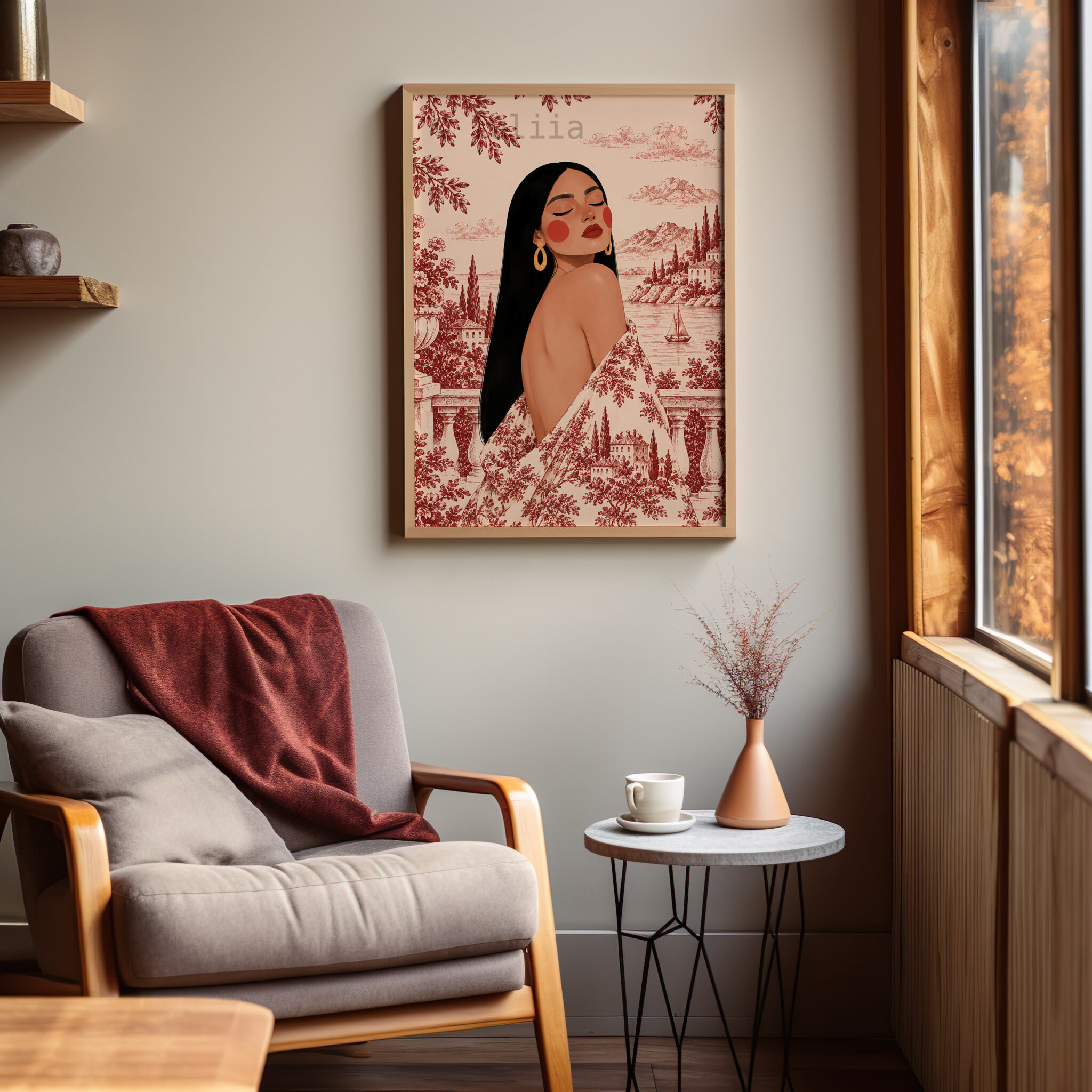
For an especially contemporary approach, Toile de Jouy wall art can combine traditional pastoral and botanical motifs with modern feminine portraits, fashion-inspired figures, bold color and editorial styling. This gives the historic pattern a completely different personality while preserving the decorative detail that makes toile recognizable.
Whether you love classic blue toile, romantic red, earthy green, black-and-cream designs or more colorful interpretations, the goal is the same: let Toile de Jouy add story and character without allowing the room to become visually overloaded.
What Is Toile de Jouy?
Toile de Jouy is associated with decorative printed textiles that became famous through the manufactory established in Jouy-en-Josas, France, in the eighteenth century. The most recognizable designs feature detailed scenes printed in one dominant color on a light background.
Pastoral landscapes, figures, animals, trees, architecture and botanical details are commonly associated with the style, although historic toile designs were much broader than the familiar pastoral scenes seen today.
In contemporary interiors, the term Toile de Jouy is often used more broadly for artwork, wallpaper and textiles inspired by this narrative, monochromatic decorative style.
That makes toile particularly interesting for modern wall decor. It already contains many of the elements that make artwork visually engaging: movement, storytelling, pattern, human figures and decorative detail.
What Does “Toile de Jouy” Mean?
The French word toile means cloth or canvas, while Jouy refers to Jouy-en-Josas, the French town associated with the historic manufacture of these printed textiles.
Literally, “Toile de Jouy” refers to cloth from Jouy.
Over time, the name became strongly associated with the recognizable style of decorative printed scenes that many people now simply call “toile.”
What Is the Difference Between “Toile” and “Toile de Jouy”?
Technically, the words are not identical. “Toile” simply means cloth in French and can refer to fabric more generally. Historically, “Toile de Jouy” referred specifically to printed textiles produced in Jouy-en-Josas.
In modern English-language decorating, however, “toile” is commonly used as shorthand for Toile de Jouy-style patterns: detailed scenic imagery printed repeatedly against a lighter ground.
For interior styling, you will therefore often see terms such as blue toile, red toile, toile wallpaper and toile wall art used even when the design was not historically produced in Jouy.
How Do You Pronounce Toile de Jouy?
In English, Toile de Jouy is generally pronounced approximately “twahl duh zhoo-ee.”
You do not need perfect French pronunciation to shop or decorate with the style, but knowing the term makes it easier to distinguish Toile de Jouy from more general floral, botanical and French country patterns.
Is Toile de Jouy in Style in 2026?
Yes, Toile de Jouy can feel very current in 2026 when it is styled in a modern way. The broader interior direction is moving toward rooms with more personality, historical references, detailed pattern, texture and character rather than completely anonymous minimalism.
That makes toile particularly relevant because it offers something simple neutral decor often does not: storytelling.
The modern version, however, is less about recreating a fully coordinated eighteenth- or nineteenth-century room. Instead, toile can be paired with modern furniture, contemporary lighting, simple bedding, natural materials, bold artwork and cleaner architectural elements.
This contrast is what makes the pattern feel fresh.
Is Toile Back in Style?
Toile repeatedly returns because it can be reinterpreted rather than simply reproduced. Traditional blue-and-white pastoral toile remains recognizable, but modern versions now appear in green, burgundy, black, pink, brown and unexpected color combinations.
The subject matter can change too. Modern toile-inspired designs may include fashion figures, urban scenes, contemporary storytelling, female portraits or botanical compositions rather than purely pastoral imagery.
This ability to change while remaining recognizable gives toile more staying power than many short-lived decorative trends.
How to Decorate with Toile de Jouy
The easiest way to decorate with Toile de Jouy is to decide first whether you want it to be the focal point or a supporting pattern.
If toile will be the focal point, use it in one visually important place: a large artwork, wallpapered wall, upholstered headboard, curtains or statement chair.
If you want a quieter result, introduce toile through one or two pieces of wall art, cushions, a small upholstered object or a decorative textile.
The mistake to avoid is adding toile everywhere simply because the pieces match. Modern interiors usually look stronger when the pattern has space around it.
Toile de Jouy Wall Art: The Easiest Way to Use the Pattern
Wall art is one of the easiest ways to introduce Toile de Jouy because it gives you the visual character of the pattern without committing an entire wall, sofa or room to it.
A toile print can add French-inspired detail to a neutral bedroom. A larger feminine portrait can create a focal point in a living room. A group of coordinated toile artworks can create a decorative gallery wall.
Wall art also makes it easier to use more unusual toile colors. Burgundy, olive green, black, red or peach may feel too strong across an entire wallpapered room but can work beautifully within a framed artwork or canvas.
Explore Toile de Jouy Wall Art featuring feminine portraits, botanical details, pastoral patterns and modern French-inspired compositions for bedrooms, living rooms and personal spaces.
How to Make Toile de Jouy Look Modern
The fastest way to make Toile de Jouy look modern is to avoid treating it as part of a historical costume set.
You do not need matching toile curtains, bedding, wallpaper and upholstery. Instead, allow one decorative element to contrast with simpler pieces around it.
A modern approach can include:
- Toile wall art above a simple contemporary bed
- A traditional toile print in a clean black or natural wood frame
- A feminine toile portrait beside modern lighting
- Blue toile paired with warm wood and cream upholstery
- Green toile paired with olive, black and brass accents
- Red or burgundy toile against neutral walls
- Toile artwork combined with simple striped or checked textiles
The decorative complexity stays inside the artwork while the rest of the room gives it breathing space.
How to Use Toile de Jouy Without Making a Room Look Dated
Toile starts to feel dated when every element is overly coordinated, the furniture is equally ornate, and there is no visual contrast between traditional and contemporary elements.
To avoid that effect, mix periods and textures.
A feminine toile portrait can work with a modern upholstered bed. A blue pastoral print can sit above a clean-lined console. A traditional pattern can be framed in simple black instead of an ornate gold frame.
Scale also matters. One confident, larger toile artwork often looks more contemporary than several very small decorative prints scattered around the room.
Finally, leave negative space. A detailed toile composition looks stronger when there is enough plain wall around it to appreciate the pattern.
What Colors Go Well With Toile de Jouy?
The best colors depend on the dominant color of the toile itself. You do not need to match every tone exactly. Instead, repeat one or two colors from the artwork and introduce neutrals that allow the pattern to stand out.
Blue Toile de Jouy
Blue toile is one of the most classic choices and is also one of the easiest to modernize.
Pair blue toile with:
- Cream
- Warm white
- Natural wood
- Navy
- Soft brown
- Muted yellow
- Terracotta
- Brass
Blue-and-cream toile can feel fresh in bedrooms, living rooms and dining areas when combined with natural textures and modern furniture.
Red and Burgundy Toile de Jouy
Red toile creates a stronger and more dramatic interior. Burgundy and muted red are particularly effective when you want the space to feel rich rather than overly romantic.
Pair red toile with cream, dark wood, soft pink, warm beige, brown, brass, muted green or black.
A red toile artwork can become the focal point of a bedroom with neutral bedding or a living room with cream upholstery.
Green Toile de Jouy
Green toile can feel earthy, botanical and slightly more relaxed than classic blue.
Olive and sage work beautifully with cream, beige, natural wood, warm brown, black, brass, blush and burgundy.
Green toile also pairs naturally with botanical decor because the palette already connects with plants and organic materials.
Black Toile de Jouy
Black-and-cream toile can feel surprisingly modern. The high contrast gives the detailed pattern a more graphic quality.
Pair it with cream, white, warm beige, natural wood, soft brown or one stronger accent such as burgundy, olive or muted pink.
Black toile is especially effective in rooms where you want French-inspired detail without creating an overly romantic atmosphere.
Pink, Peach and Softer Toile Palettes
Softer toile palettes work well in bedrooms, dressing areas and feminine interiors. To keep them from becoming overly sweet, introduce stronger grounding colors.
Blush toile can work with brown, black, burgundy, olive, cream or warm wood. Peach toile can be balanced with terracotta, dark green, beige or soft black.
Does Toile de Jouy Have to Be Blue and White?
No. Blue and white may be the most recognizable combination, but Toile de Jouy does not need to be blue.
Red, green, burgundy, black, brown, pink and multicolored interpretations can all work beautifully.
Choosing a less expected color is also one of the easiest ways to make toile feel more personal and contemporary.
What Patterns Look Good With Toile?
Because Toile de Jouy is already visually detailed, the easiest patterns to combine with it are usually simpler and more structured.
Stripes
Stripes work extremely well with toile because their geometry balances the narrative detail of the toile pattern. A narrow stripe can feel classic, while a wider stripe creates a stronger modern contrast.
Checks and Gingham
Checks add structure and can make toile feel less formal. They are especially useful in French country, eclectic and modern cottage interiors.
Simple Geometric Patterns
Small geometric patterns can complement toile when the scale is clearly different. Avoid choosing another equally detailed pattern at exactly the same size.
Florals
Florals can work with toile, but they require more control because both patterns can be visually detailed.
Choose a floral with a noticeably different scale or simplified composition. For example, a detailed toile artwork can work with a larger, looser floral textile rather than another tiny narrative print.
Solid Textures
Technically not a pattern, but solid linen, velvet, wool, boucle and other textured materials are some of the best companions for toile. They add depth without creating competition.
How Do You Combine Patterns With Toile?
When combining patterns, vary the scale. If the toile contains small detailed scenes, pair it with a larger stripe, bold check or more open floral pattern.
Then connect the patterns through color. They do not need to contain exactly the same palette, but sharing one or two tones will make the combination feel intentional.
Finally, include solid areas between patterns. Plain walls, bedding, upholstery or rugs give the eye somewhere to rest.
What Patterns Do Not Go Together With Toile?
There are no absolute rules saying two patterns can never work together. The problem usually comes from competition rather than the type of pattern itself.
Two highly detailed patterns in the same scale can fight for attention. Several patterns with completely unrelated colors can make the room feel accidental. And covering every surface with a different motif can remove any clear focal point.
If two patterns both demand attention, reduce one of them through scale, color or quantity.
What Is the 3-5-7 Rule in Decorating and Can You Use It With Toile?
The 3-5-7 rule is a decorating idea based on grouping objects in odd numbers, which often creates a more relaxed visual rhythm than perfectly symmetrical pairs.
You do not need to follow it literally, but it can be useful when styling a console, shelf or gallery wall near Toile de Jouy artwork.
For example, you might create a group of three: one toile artwork, one lamp and one ceramic object. Or combine three artworks with different subjects but related colors.
The rule is less important than overall proportion, but it can help prevent decorative arrangements from feeling overly rigid.
Is Toile Wallpaper Outdated?
No. Toile wallpaper is not inherently outdated. What can feel dated is the way it is styled.
A toile wallpaper paired with heavy matching curtains, identical upholstery and highly ornate furniture may create a very traditional result. That may be perfect if that is the intention, but it is not the only way to use it.
Modern toile wallpaper can work as one statement surface combined with cleaner furniture, simple bedding, contemporary lighting and modern artwork.
If you like the look of toile but do not want the commitment of wallpaper, Toile de Jouy wall art is an easier alternative. You can introduce the same narrative pattern and French-inspired mood while keeping the wall itself neutral.
Toile de Jouy Wall Art vs Toile Wallpaper
Wallpaper creates a larger immersive effect, while wall art creates a controlled focal point.
Choose toile wallpaper if you want the pattern to define the architecture and atmosphere of the whole room.
Choose toile wall art if you want:
- An easier way to introduce the style
- Less visual pattern across the room
- The ability to change artwork later
- A strong focal point rather than an all-over pattern
- A more contemporary mix of traditional pattern and modern interiors
For apartments, rentals, modern bedrooms and rooms with already decorative textiles, wall art is often the more flexible option.
How to Decorate a Bedroom With Toile de Jouy
Bedrooms are one of the easiest places to use toile because the pattern naturally adds softness and visual storytelling.
A single feminine toile portrait can hang above the bed or dresser. Two coordinating prints can work near a vanity. A larger portrait can become the focal point opposite the bed.
For a calmer room, use cream, blue, beige, sage or muted green toile. For a more dramatic bedroom, try burgundy, red, black or deeper green.
Keep bedding simpler if the artwork is highly detailed. Linen, solid cotton, subtle stripes and textured neutrals allow the toile artwork to remain the main decorative feature.
How to Decorate a Living Room With Toile de Jouy
In a living room, toile works best when it has enough scale to compete with larger furniture.
A small detailed print may disappear above a large sofa. Instead, choose a larger Toile de Jouy artwork or create a coordinated gallery wall.
Pair detailed toile with simple upholstery, warm wood, modern lighting and solid cushions. If you already have patterned rugs or upholstery, repeat only one or two colors from the toile rather than adding more unrelated patterns.
Modern feminine toile portraits can work especially well in living rooms because they combine the decorative complexity of the pattern with the stronger focal presence of portrait art.
How to Use Toile de Jouy in a Dining Room
Dining rooms can handle more decorative detail because they are spaces designed for gathering and atmosphere.
Toile wall art can work above a sideboard, console or dining bench. Blue toile can create a classic European feeling, while red, green or black toile can make the room more dramatic.
Pair the artwork with simple tableware, ceramics, linen and wood rather than trying to repeat the toile pattern across the entire dining area.
How to Use Toile de Jouy in a Dressing Room or Vanity Area
Dressing rooms and vanity areas are ideal for contemporary feminine toile art.
Female portraits, fashion-inspired figures, floral toile backgrounds and elegant styling can make the space feel personal and polished.
A vertical portrait works well beside a mirror or vanity. Larger toile artwork can sit above a dresser, while several coordinated portraits can create a fashion-inspired gallery wall.
Explore more related portrait artwork in the Feminine Wall Art collection.
Can Toile de Jouy Work in a Modern Home?
Yes. Toile can actually create stronger contrast in a modern home than in a traditionally decorated one.
A clean-lined sofa, simple bed, contemporary lamp or minimalist console gives the detailed toile pattern a new context. Instead of looking historic, it becomes the decorative counterpoint to modern furniture.
This contrast between old and new is often more interesting than trying to make every element belong to exactly the same style.
Can Toile de Jouy Work in Scandinavian Interiors?
Yes, but use it selectively. Scandinavian interiors usually rely on simplicity, natural materials and calm color, so one Toile de Jouy artwork can introduce character without overwhelming the room.
Blue, cream, muted green, black or warm neutral toile works particularly well with natural wood, pale walls, linen and simple furniture.
Choose a clean frame and allow plenty of empty wall around the artwork.
Can Toile de Jouy Work in Maximalist Interiors?
Absolutely. Toile’s detailed storytelling makes it naturally compatible with maximalist interiors.
In this case, you can be more adventurous with pattern and color. Combine toile with stripes, florals, checks, decorative objects, richer textiles and stronger furniture colors.
The key is still repetition. Repeat selected colors throughout the room so the layers feel collected rather than random.
For brighter and more expressive pairings, explore Maximalist & Dopamine Wall Art.
Can Toile de Jouy Work With Abstract Modern Art?
Yes. The contrast can be particularly effective.
Toile contains narrative detail and recognizable imagery, while abstract art introduces larger shapes, negative space and less literal visual language.
Combining the two can keep a French-inspired room from becoming overly traditional.
A detailed feminine toile portrait beside a simpler abstract composition can create a layered gallery wall with both decorative history and contemporary energy.
Browse complementary pieces in Abstract & Modern Wall Art.
How to Style Feminine Toile de Jouy Wall Art
Feminine Toile de Jouy wall art combines two strong visual elements: the detail of toile and the presence of a female figure.
Because the artwork already contains plenty of visual information, it often works best with simpler surroundings.
Style a feminine toile portrait with:
- A simple upholstered bed
- A modern sideboard
- A clean vanity
- Natural wood furniture
- Simple brass or black lighting
- Solid or lightly textured textiles
- One or two repeated accent colors from the artwork
This keeps the portrait feeling like real statement art rather than another decorative pattern in an already busy room.
How to Create a Toile de Jouy Gallery Wall
A Toile de Jouy gallery wall does not need to contain only toile prints.
In fact, mixing subjects usually creates a more collected result.
You can combine:
- Feminine toile portraits
- Botanical artwork
- Floral prints
- Simple abstract compositions
- Fashion-inspired portraits
- Black-and-white artwork
Choose one common element to connect them. This might be blue throughout the gallery, repeated cream backgrounds, similar wood frames or a shared feminine mood.
Vary scale so the gallery wall has hierarchy rather than looking like a grid of identical small images.
What Frames Look Best With Toile de Jouy Wall Art?
The frame can completely change the mood of Toile de Jouy artwork.
Natural Wood Frames
Natural wood softens the detail and works well in Scandinavian, warm modern, botanical and relaxed French-inspired rooms.
Black Frames
Black creates stronger contrast and makes toile feel more graphic and contemporary. It works particularly well with fashion-inspired or black-and-cream compositions.
White Frames
White frames create a light, clean effect and work well with blue, blush and softer toile palettes.
Decorative or Antique-Inspired Frames
More ornate framing can enhance chateaucore, traditional and romantic interiors. Use it deliberately, especially if the artwork itself is already highly detailed.
Does Toile de Jouy Work With Chateaucore Decor?
Yes. Toile de Jouy naturally fits chateaucore because both styles draw on European decorative history, storytelling and romantic detail.
Combine toile artwork with vintage-inspired furniture, ornate mirrors, books, brass, dark wood, floral textiles, linen and warm lighting.
To keep the room current, include simpler modern elements as well. A clean sofa or contemporary lamp can prevent chateau-inspired decor from becoming overly theatrical.
Does Toile de Jouy Have to Look French Country?
No. Toile de Jouy can work in French country interiors, but it can also be modern, feminine, maximalist, eclectic, Scandinavian-inspired or fashion-focused.
The surrounding furniture and color palette determine much of the final mood.
A blue pastoral toile in an antique frame may feel traditional. The same artwork in a clean black frame above a modern console can feel completely different.
How Much Toile Is Too Much?
There is no universal limit, but the room needs visual hierarchy.
If the wallpaper, curtains, bedding, chair and artwork all contain similarly detailed toile patterns, nothing has room to become the focal point.
For most modern interiors, choose one dominant toile application and let the other elements support it.
If you intentionally want a maximalist or traditional “all-over” room, you can use more toile, but change scale and introduce solid colors between patterned surfaces.
What Makes Toile de Jouy Look Expensive?
Toile looks more elevated when it is treated as art rather than novelty decor.
Use good scale, controlled color, strong framing and enough negative space. Pair it with natural materials and avoid adding decorative objects purely because they are French-themed.
A single sophisticated toile portrait above a console can look more refined than a room full of unrelated French-inspired accessories.
What Makes Toile de Jouy Look Old-Fashioned?
Toile can start to feel old-fashioned when everything matches too perfectly, furniture is overly ornate, color is overly muted and there is no contrast from contemporary pieces.
That does not mean traditional styling is wrong. But if you want a modern result, introduce something unexpected: a modern female portrait, black frame, sculptural lamp, bold color, contemporary furniture or abstract art.
How Do You Choose Toile de Jouy for Your Interior?
Start with four questions:
- What room is the artwork for?
- Do you want toile to blend in or become the focal point?
- Which colors already exist in the room?
- Do you prefer classic toile or a more modern interpretation?
For a calm bedroom, you might choose blue, cream or green. For a dramatic living room, red, burgundy or black can create stronger impact. For a dressing room, feminine portrait toile can introduce fashion and personality.
The best choice is not necessarily the most traditional toile. It is the version that feels natural in your own interior.
Toile de Jouy Decorating FAQ
What does Toile de Jouy mean?
“Toile” means cloth or canvas in French, while Jouy refers to Jouy-en-Josas, the French town associated with the historic production of these printed textiles. Today, Toile de Jouy commonly describes decorative scenic patterns inspired by this tradition.
What is the difference between toile and Toile de Jouy?
Toile is the French word for cloth. Historically, Toile de Jouy referred specifically to printed textiles produced in Jouy-en-Josas. In modern interior design, “toile” is frequently used as shorthand for Toile de Jouy-style scenic patterns.
Is Toile de Jouy in style in 2026?
Yes. Toile fits well with the renewed interest in detailed pattern, historical references, expressive interiors and more personal home decor. The most modern approach is to mix toile with contemporary furniture, simpler frames, controlled color and plenty of negative space.
Is toile wallpaper outdated?
No. Toile wallpaper can look traditional or contemporary depending on how it is styled. Pairing it with cleaner furniture, modern lighting and simpler textiles can give the pattern a much fresher look.
Is Toile de Jouy back in style?
Toile continues to be reinterpreted through new colors, contemporary imagery and updated interiors. Modern toile can include fashion-inspired figures, female portraits, unexpected colors and new narratives while retaining the detailed character of classic Toile de Jouy.
What patterns look good with toile?
Stripes, checks, simple geometric patterns, larger-scale florals and textured solids can all work with toile. The most important rule is to vary the pattern scale and repeat one or two colors between the designs.
Can you mix floral patterns with toile?
Yes. Choose a floral with a noticeably different scale from the toile and connect the two through color. Avoid using two extremely detailed small-scale patterns next to each other unless you intentionally want a dense maximalist effect.
What colors go best with blue Toile de Jouy?
Blue toile pairs well with cream, warm white, natural wood, navy, brown, muted yellow, terracotta and brass. The combination can feel traditional or modern depending on the surrounding furniture and framing.
What colors go with green Toile de Jouy?
Green toile works beautifully with cream, beige, natural wood, brown, black, brass, blush and burgundy. Olive green is particularly easy to use in botanical and warm modern interiors.
Can Toile de Jouy be red or black?
Yes. Toile de Jouy does not have to be blue. Red, burgundy, black, green, pink and other colorways can create very different moods while preserving the decorative toile aesthetic.
How do you make Toile de Jouy look modern?
Use toile selectively, pair it with clean-lined furniture, choose contemporary frames, introduce modern lighting and leave enough negative space around detailed patterns. Modern feminine portraits and fashion-inspired toile artwork can also make the style feel much more current.
Can Toile de Jouy work in a modern bedroom?
Yes. A toile artwork above a bed, dresser or vanity can add detail to a modern bedroom without overwhelming the space. Keep surrounding bedding and furniture simpler if the artwork is highly patterned.
Can Toile de Jouy work in Scandinavian interiors?
Yes. Choose restrained colors such as blue, cream, muted green, beige or black, use simple natural wood frames and keep the rest of the room relatively calm. One detailed toile artwork can add character to an otherwise minimalist space.
Does Toile de Jouy work with maximalist decor?
Yes. Toile is naturally suited to layered interiors because of its detailed pattern and storytelling. Combine it with florals, stripes, checks and stronger color, but repeat key tones throughout the room to keep the result cohesive.
What is better: Toile de Jouy wallpaper or wall art?
Wallpaper creates an immersive patterned room, while wall art gives you a more flexible focal point. Toile de Jouy wall art is especially useful if you want the style without covering an entire wall or if you want to mix traditional pattern with modern interiors.
Where can I buy modern Toile de Jouy wall art?
Browse original French-inspired feminine portraits, botanical toile designs, blue, green, red and contemporary decorative artwork in the Iuliia.Store Toile de Jouy Wall Art collection.
Shop Toile de Jouy Wall Art
Explore Toile de Jouy Wall Art featuring modern feminine portraits, floral details, pastoral patterns, botanical compositions and French-inspired artwork for bedrooms, living rooms, dressing areas and expressive modern interiors.
Choose classic blue toile, rich red and burgundy designs, botanical greens, black-and-cream compositions or contemporary feminine interpretations designed to bring the storytelling quality of Toile de Jouy into modern homes.