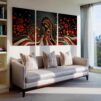


A set of 3 prints, often referred to as triptych wall art, can instantly elevate a space — but only when it’s hung correctly. Many interiors fail to achieve the intended balance not because of poor artwork choices, but because of simple placement mistakes that disrupt proportion and flow.
Understanding these common errors can make the difference between a space that feels thoughtfully designed and one that feels visually off.
Choosing Prints That Are Too Small
One of the most frequent mistakes is selecting a set of 3 prints that is too small for the wall. When artwork doesn’t visually connect with the furniture beneath it, the entire composition feels disconnected.
As a general guideline, the total width of all three prints combined should cover roughly two-thirds to three-quarters of the width of the sofa, console, or bed below. Anything smaller risks looking lost rather than intentional.
Incorrect Spacing Between Prints
Spacing plays a critical role in how a triptych is perceived. Too much distance between prints causes them to read as separate pieces rather than a unified set. Too little space, on the other hand, makes the composition feel cramped.
In most interiors, spacing of approximately 5–8 cm between each print creates the best visual balance while maintaining cohesion.
Hanging the Set Too High
Another common error is hanging the artwork too close to the ceiling. This pulls attention upward and breaks the visual relationship between the art and the furniture.
The center of a set of 3 prints should generally sit at eye level, around 145–150 cm from the floor. When placed above a sofa or sideboard, leaving 15–25 cm of space between the furniture and the artwork helps anchor the composition.
Ignoring Alignment and Leveling
Even slight misalignment between prints can disrupt the rhythm of a triptych. Crooked or uneven panels are immediately noticeable and can make an otherwise beautiful set feel careless.
Before hanging, always measure and mark placement carefully. Using a level and planning the layout on the floor or with paper templates can prevent this mistake entirely.
Mixing Frames or Materials Within One Set
Consistency is key when working with a set of 3 prints. Mixing different frame styles, colors, or materials within the same triptych often breaks the visual flow and creates unnecessary distraction.
Whether you choose framed prints or canvas artwork, keeping all three panels uniform ensures the set reads as a single, cohesive piece.
Choosing a Theme Without Cohesion
While variation within a triptych adds interest, a lack of cohesion can make the set feel random. Successful triptychs share a unifying element — whether it’s color palette, subject matter, or artistic style.
This doesn’t mean the prints need to be identical. Subtle differences across panels are what give triptych wall art its dynamic appeal, but they should always feel connected.
Not Planning the Layout in Advance
Hanging a set of 3 prints without planning often leads to rushed decisions and uneven spacing. Skipping the planning phase increases the chance of unnecessary wall damage and visual imbalance.
Taking time to test placement before committing allows adjustments that result in a cleaner, more intentional final look.
Why Avoiding These Mistakes Matters
Triptych wall art works because of proportion, rhythm, and balance. When these principles are ignored, the set loses its impact — even if the artwork itself is beautiful.
A properly hung set of 3 prints enhances the architecture of the room, reinforces the furniture layout, and creates a focal point that feels deliberate rather than accidental.
Explore our curated collection of Set of 3 Wall Art designed to work harmoniously in modern living spaces.